
EQUIST Workshop to Identify Strategies for U5M Reduction in Sierra Leone
In partnership with UNICEF HQ and UNICEF Sierra Leone, Community Systems Foundation (CSF) facilitated a capacity building workshop that enabled health policy planners to use the Equitable Impact Sensitive Tool (EQUIST).
This was done to support the government in modeling the impact of scaling up life-saving health and nutrition interventions, to reduce child mortality in the country.
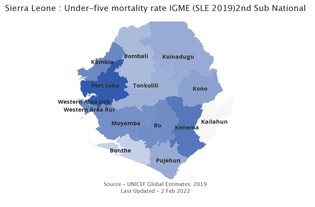
This workshop was held at the Wusum Hotel inMakeni, Sierra Leone, from 13-17 June 2022.The workshop aimed to help participants better understand which health and nutrition interventions could help address under-five mortality in the country; (107.8 deaths per 1000 live births) in 2020, as estimated by the United Nations Inter-agency Group for Child Mortality Estimation (UNIGME).
Additionally, the participants analyzed the health and nutrition situation at granular (district) levels to identify contextual bottlenecks and strategies to overcome them.
One of the leading causes of child mortality in Sierra Leone is malaria.

The workshop guided participants in using EQUIST to view and select specific strategies and interventions that could assist them in reducing the under five mortality caused by malaria.Participants focused on Water Sanitation and Hygiene-related (WASH) interventions to combat the communicable disease, as well as other interventions, such as providing mosquito nets or antimalarials, for prevention and treatment respectively.EQUIST provides a model which analyzes the impact of intervention coverage levels on mortality numbers and rates and compares effectiveness of chosen strategies.
It then analyzes the strategies and computes the cost effectiveness of the interventions by comparing the per capita marginal cost and the number of lives saved per $US 1 million spent.Based on the interventions selected by the participants, cost and impact reports were generated.
Having access to these outputs guided them in informing health plans and developing investment cases (ie. health policy and finance interventions that are cost effective and evidence based).At the close of the workshop, individuals confidently presented their reports and described to their peers the methodology that led to their conclusions.Due to the success of the workshop, Government officials saw the potential of EQUIST in supporting health-related decisions at the lowest administrative level, Known as "chiefdoms," in Sierra Leone.
This granular data would support decision makers in creating meaningful change at the health facility level.This capacity building workshop was led by CSF’s Health Advisor, Shahrouh Sharif, together with UNICEF Health Section technical staff from Headquarters and the Sierra Leone Country Office.
The workshop was attended by 40 participants including health officials, DPPI staff, the Director General of Health,, and UNICEF’s Sierra Leone Country Office staff, including the Chiefs of Health, Nutrition, and Social Behavioral Change sections.The collaboration among all of these partners remains essential to create solutions that lead to a stronger healthcare system.CSF is happy to be back in the field and to have the opportunity to assist Sierra Leone in strengthening evidence based planning with a model that provides strategies towards cost effective health interventions to reduce under five mortality rates.
Further collaboration in Sierra Leone is expected, providing extended, multi-sectoral training on multiple levels of government in the implementation of EQUIST.
CSF looks forward to further collaboration and implementationof EQUIST in Sierra Leone.

19