
Across the global development landscape, the role of data remains central and essential, while technology has rapidly and exponentially increased the power of what can be done with data.
Systems such as OpenEMIS and DataForAll (DFA) were designed to support countries in collecting, managing, and using data more effectively. Today, as advances in artificial intelligence (AI) reshape the broader field of software development, new opportunities are emerging to further strengthen how data is interpreted and applied.
At CSF, AI is being approached in a measured and practical way—focused not on novelty, but with care, on improving how our teams work and how users engage with trusted data.
Strengthening Internal Workflows
CSF teams are increasingly leveraging AI tools and agents to improve efficiency across a range of internal processes. From supporting software development workflows to enhancing documentation, testing, and data analysis tasks, these tools are helping teams reduce time spent on repetitive activities and focus more on higher-value work.
This shift reflects a broader trend across the technology sector: the tools available to developers and analysts are becoming more capable and more accessible. When used thoughtfully, they can accelerate delivery without compromising quality. This principle remains central—AI is adopted where it adds clear value, and always with attention to reliability, transparency, and accountability.
Introducing AI into CSF Products
In parallel with internal use, CSF has begun integrating AI capabilities directly into its platforms. These efforts are grounded in a simple objective: to make data more usable, more understandable, and more actionable for the people who rely on it.
Two recent developments illustrate this direction.
OpenEMIS Chatbot
The OpenEMIS Chatbot provides a new interface for interacting with education data. Users can query data collected and produced through OpenEMIS using natural language, allowing them to access information more quickly and intuitively.
Rather than navigating complex dashboards or predefined reports, users can ask questions directly and receive relevant responses based on the underlying data. This lowers barriers to access and supports more responsive use of information within ministries of education and partner organizations.
AI Insights in DataForAll
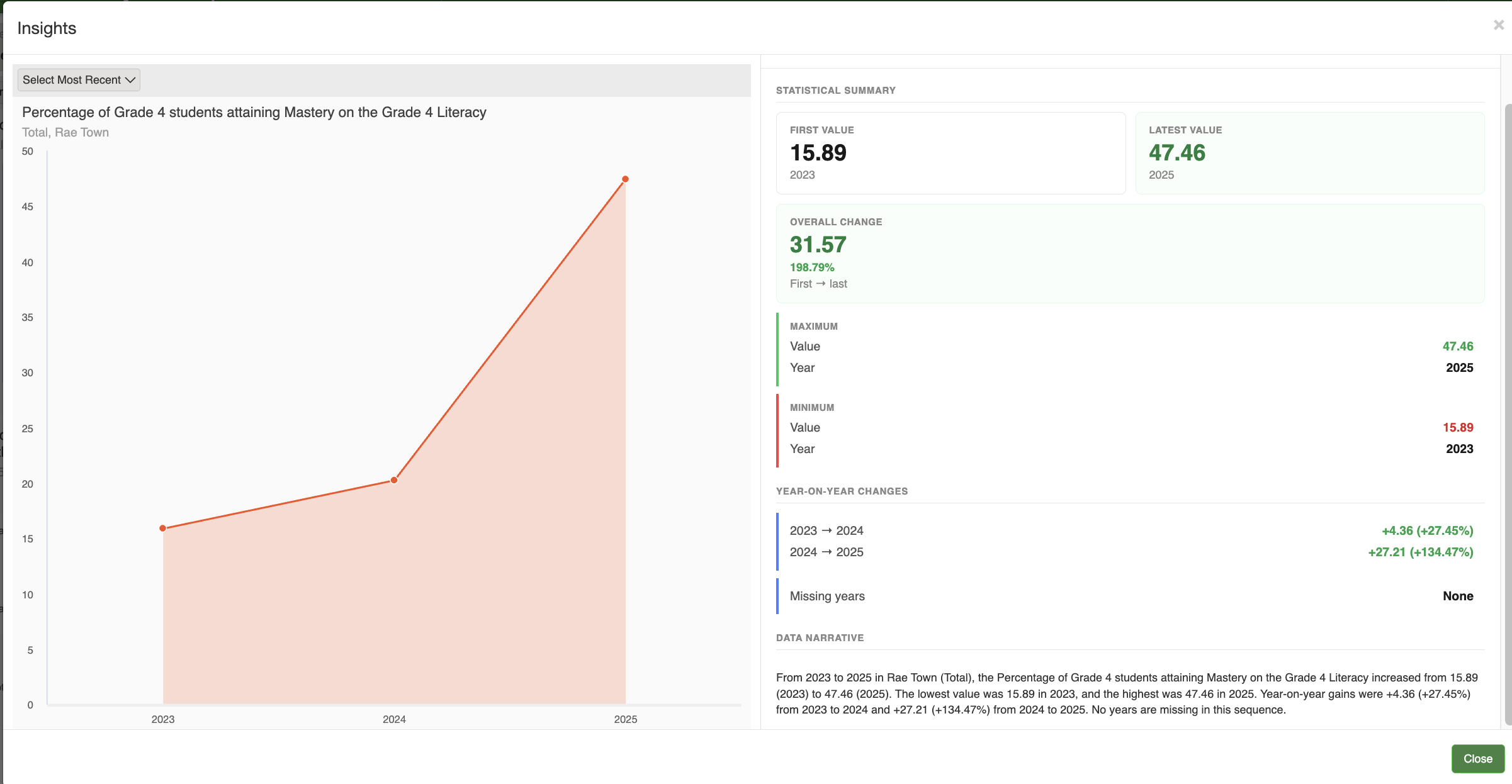
Within the DataForAll Visualizer, AI Insights introduces an intelligent layer on top of data visualization. It transforms charts, indicators, and datasets into clear narrative interpretations—making data easier to understand, explain, and act upon.
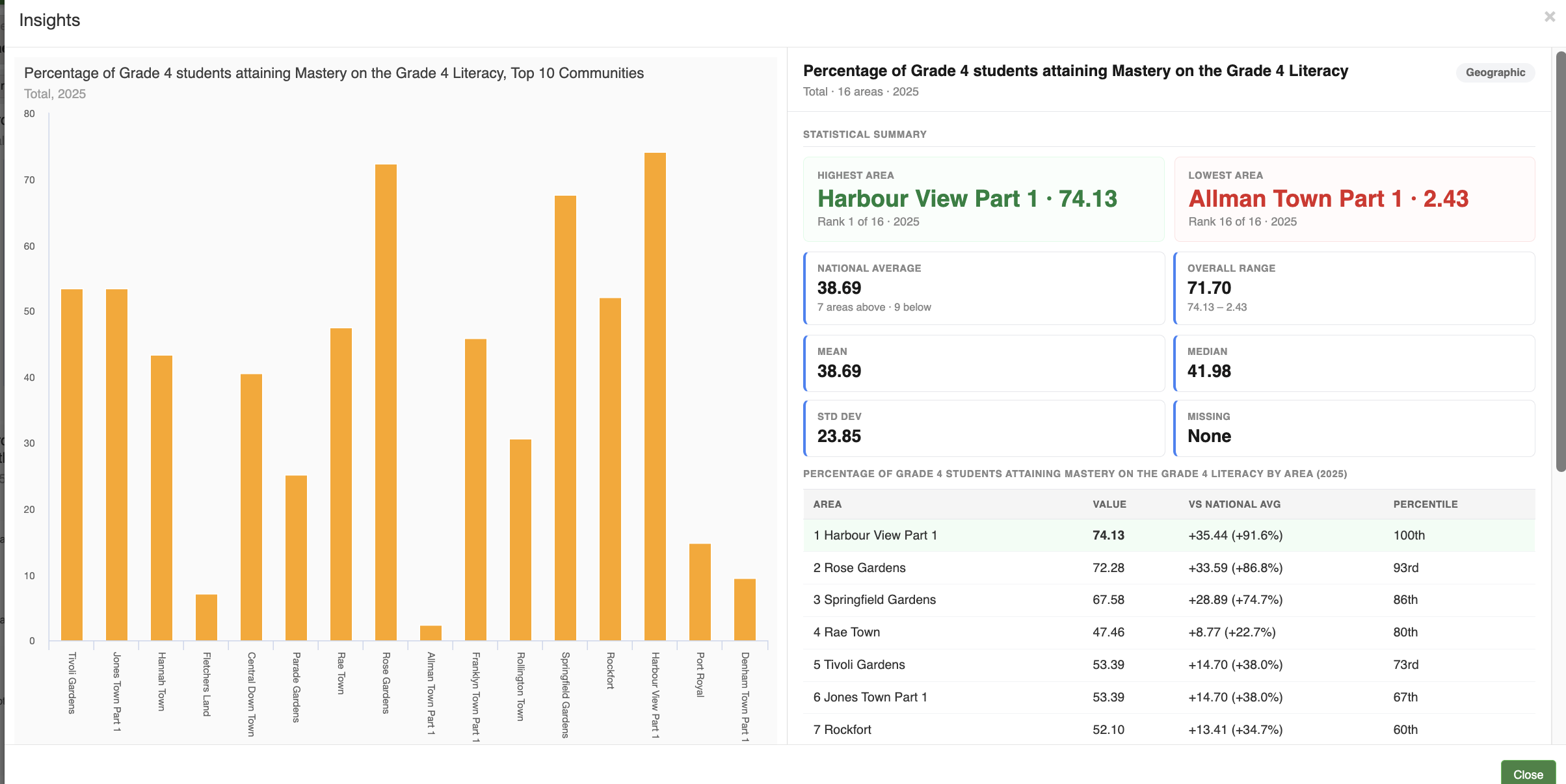
Importantly, AI Insights is grounded entirely in the data available within the platform. It does not extrapolate, predict, or generate assumptions beyond what the data shows. Instead, it provides contextual interpretation based strictly on existing trends, values, and relationships already present in the dataset.
With AI Insights, users can:
- Generate narrative summaries directly from available data
- Highlight patterns, anomalies, and changes within reported indicators
- Support evidence-based reporting and decision-making
- Make complex datasets more accessible to non-technical stakeholders
- Reduce the time required to interpret large volumes of information
For governments, ministries, and development partners, the challenge is no longer collecting data—it is turning trusted data into meaningful understanding. AI Insights helps bridge that gap by enabling data to “speak,” while remaining fully anchored to the underlying evidence.
A Practical Path Forward
The rapid pace of change in AI and software development is clear. New tools are expanding what is possible in data analytics, user interaction, and system design. However, the value of these technologies depends on how they are applied.
At CSF, the focus remains consistent: strengthening systems that support evidence-based decision-making in real-world contexts. AI is being incorporated carefully, with attention to the needs of users, the integrity of data, and the importance of transparency.
As OpenEMIS, DataForAll, and other CSF initiatives continue to evolve, AI will play a growing role—but always in service of the same goal: helping countries turn data into insight, insight into action and action into impact.